February 26, 2026

Stone Age Magic Items

I'm writing a Stone Age hexcrawl for The Vanilla Game based on the Outdoor Survival map. Before I got too far ahead of myself, I realized I should write treasure stocking tables for the villages and monster hoards. And before that, I decided to do the Magic Items tables. One of the features of fantasy paleolithic life I wanted to add are Conanesque fallen evil snakemen structures all around, so the Snakeman Treasures are just normal, "modern" dungeon-crawl treasures given an ophidian bent. Mostly they're just "as X Treasure in The Vanilla Game". I'll add them once I finish them all.

Edit: Reader, I finished them all. 

One invaluable source for inspiration was Sofinho's 3d100 Items for Pariah. I'll be honest, the research I conducted before deciding to write my own Stone Age hexcrawl setting consisted of me googling "Stone Age Equipment TTRPGs" and "Prehistoric Encounters by Biome D&D" and not getting much back, so I didn't know about Pariah until after starting. But it's sick as hell and I almost certainly stole from it after losing inspiration, getting it linked, reading it, then forgetting what I read after a week and a half of not writing anything. 

Magic Items

  1. Carven Eye. An agate, carved and polished cunningly into the exact shape of an eyeball. When placed in an empty socket, grants sight, no matter how far from the wearer it gets. A new wearer can claim it by cutting out their own eye. The previous owner will certainly want it back.
  2. Cave Bear Skin. The pelts of a cave bear, worn as a cloak. Still carries the vicious strength of the beast in its animus. Wearing it confers +3 to Strength and +2 to melee attack damage, but the wearer reduces their Intelligence by 3 and cannot speak or differentiate friend from foe. After being taken off, the skin causes its wearer to fall into a pseudo-hibernation (save vs sleep) for 2d6 hours or until their calorie deficit is addressed.
  3. Dancing Drum. Worn and small enough to carry on a belt or sash, made of old coconut shells stretched with red-monkey skin, still furred. When beaten, all within earshot must save or dance uncontrollably, including the musician. Fighting while dancing is nearly impossible.
  4. Elephant Headdress. A fearsome skull-helmet, made from the sacred tusks and bones in a hidden pachyderm graveyard. Allows understanding of all elephant-like beings. -5 to reaction rolls vs. Sabre-Toothed Cats.
  5. Eternal Light. A jag of tar-soaked wood from an ancient lightning-struck oak. When burnt as a torch, the light shines brighter than others, and the wood remains unconsumed.
  6. First Weapon. A polished hunk of granite that sits invitingly in the hand. The first ape who slew another hefted this stone and used it to crack his brother's skull. +3 to AV and Damage against primates.
  7. Flowing Ewer. A rough-hewn stone ewer, capped by a hardened leather lid. Sloshes when shaken. Can produce vinegar, salt or fresh water, urine, oil, alcohol, or poison.
  8. Headsplitter Axe. Armor is crude still, echoes of the skull protecting the brain. The stone axe joyously disregards such frivolities, eager to taste the gray matter hidden beneath. When rolling your Attack Value exactly, the axe buries itself in the skull of the enemy, dealing an additional 3d6 damage or killing them instantly. Test Strength to pull the axe back out.
  9. Invisibilty Ring. Chatoyant stone, drilled through to form a ring. The wearer becomes invisible while the ring is on, save a catlike glimmering of their eyes. Made in secret to slip away from snakeman masters ages long gone.
  10. Profane Idol. Delicate ivory figurine, the shape of a spindly, spider-curled man with an erect phallus. No facial features except a leering grin. Absorbs curses thrown against the bearer, but gives them terrible nightmares as a price (no longer gain benefits from resting, unable to regain Grit). Followers of the Venus Cult seek the destruction of their sinister obverse heresies.
  11. Scaled Spear. The haft is carved with delicate traceries of scales, the head knapped from a giant serpent's tooth. The dried venom in the poison channel remembers being whole, and seeks to reunite with reptilian stock. Does +2 damage against scaled beings, and unerringly hits reptiles when thrown. Seeks to turn on the upstart mammals that created it in mockery of their fallen ophidian overlords.
  12. Shaman Jar. Specially prepared ritual canopic jar. The shaman who uses it must be sacrificed, their heart and entrails interred inside. The body walks, immune to damage. If the organs are destroyed, the body dies and the soul is annihilated
  13. Spirit Bowl. A ritual bowl, wide as one forearm. Expertly crafted from iron-rich clay, rust spots leaking from the glaze. When filled with a medium and rang, compels a nature spirit of the same kind to arrive. Does not guarantee safety, only audience.
    1. An ember from the hearth of a slain tribe. A fire elemental appears from the coal in 1d20 minutes.
    2. The sand from a canyon previously untrod by men. An earth elemental coalesces from the surrounding soil in 1d6 hours.
    3. Water gathered from a subterranean river. A water elemental draws itself out of ambient moisture in 2d6 turns.
    4. The feathers of a hunting bird, a singing bird, a carrion bird, and a speaking bird. An air elemental appears immediately.
  14. Thirsting Knife. A cave-bear femur, sharpened to an edge and a point. Alive. Successive attacks add a cumulative +1 to damage rolls. If a strike fails to hit, the knife jerks and turns on its wielder and loses its bonus.
  15. Tooth Arrow. Pulled from the skull of a sorcerer and fitted to a shaft. Those struck by the arrow are similarly struck dumb for 1d6 rounds as taboo knowledge fills their heads. There are 32 of these arrows in existence. Victims of the teeth, should they survive, recover with an additional 1d3 spells.
  16. Trepanning Tools. Chisels, knives, and needles made of meteoric metal, soaked in clear cave water. After the procedure (save or die, unless performed by a very skilled medicine-person), the one trepanned can walk forth from their body once per day.
  17. Watchful Hood. A scrap of molded leather, which fits on the head of a bird. Anything so hooded is tamed and obeys the owner, until the hood is removed.
  18. Witch-Hair Rope. Strands of witch's hair, woven into a rope with ornaments of bone and silver. Can only be untied by the one who knotted it. 
  19. Roll on the Potion Table.
  20. Roll on the Snakeman Table.

Potions 

  1. Balm-Milk. Extracted poppy-oil and human breastmilk, as well as other, more secret ingredients. Sanctified in a henge while the Mother Star is in the sky, one of the Venus-cult rites. Heals Flesh for 2d6 points.
  2. Birdtongue. A songbird's tongue is boiled in drake-blood, the resulting mixture cut with wine to preserve the effects. Allows the drinker to listen in to the conversations of avians for 2d6 hours.
  3. Cat's Eye. The ocular jelly of a sabre-toothed cat, swimming in a wine made from the juices of an orange, conical tuber. Grants enhanced night vision to the drinker.
  4. Elixir of Immortality. The unclean blood of a Tainted One of great age carries the curse of Lightless Undeath within itself. Those who drink it become savage, blood-drinking, day-shunning undead, under their sire's sway, but no longer age or die by most mortal means.
  5. Flying Ointment. An evil witch-medicine from the far north, across mountains where the snow never melts and ice covers the land. The fat of a newborn, mixed with datura, belladona, and lead, sanctified by a shaman of the Winking Stars. Smeared on the body, grants +3 to saves vs. cold, wavering prophetic visions, and the ability to levitate and hover until the mixture is washed or wears off.
  6. Golden Mead. The ingredients of Golden Mead are jealously guarded, the preparation known only to sorcerers. Allows contact with the Spirits From the Winking Stars, to the detriment of Charisma. Stronger doses are said to induce coma and invulnerability to the forces of the Great Black beyond the sky. A holdover of snakeman technology.
  7. Grave Herbs. A special shamanic blend, bundled together and sealed with innocent blood and wax. When burnt, quiets the undead until the smoke disippates.
  8. Hidden Incense. Sprinkled onto flames, the steam produced coats everything in a shiny, semi-sticky mist, revealing any invisible or intangible spirits nearby.
  9. Rotting Poison. Can only be eaten or drunk, not applied. Causes the skin to painfully swell yellow and pus-filled, then slough off. Non-lethal, but infections will be. Three doses are enough to poison a communal stew-pot.
  10. Shaman Wax. An orange wax, gathered from a certain kind of stout palm tree then mixed with shamanic ingredients. A person coated in the wax is invisible to spirits (+2 to Saves against Magic), but is extremely flammable.
  11. Shapechange. When drunk, the drinker transforms into the kind of animal whose blood is in the mixture. Save or stay that way after 24 hours. Reviled in most tribes as the rumored source of the curse of lycanthropy, along with divinely-punished hubris, cannibalism, or bestiality.
  12. Split-Tongue. For 1d4 turns, the drinker can understand all spoken languages. They get +2 to all reaction rolls made by sentient beings, and any lies they tell are believed unless the listeners make a Save. Afterward, the drinker must Save or their tongue splits down the middle, making speech impossible.
  13. Stoneskin Lacquer. Dumped on a person, their skin roughens and hardens into nodules and leather. Count AC as 2 higher, but become unskilled at dextrous tasks. Lasts 1d6 hours, then the shell falls off, revealing unscarred, delicate raw flesh.
  14. Sweetwater. Liquid taken from the hidden spring of a water-spirit. A few drops purify all other fluids into cool, clean water.
  15. Tree-Friend. The sap-blood of an old tree-spirit must be drained in secret, away from all plant-materials. Boiled, the remaining syrup may be imbibed to pass through plants as they recognize themselves in the drinker. If any plant or object made of plants sees the ritual, they act in hatred towards the sorcerer and drinkers involved, moving into their paths.
  16. Trembling Poison. Causes violent shaking in victims. Usually coated on arrows or bladed weapons, all who suffer the trembling sickness have their Attack Values reduced by 3. Lasts 1d6 days, after which you must save or the effects are reduced but permanent.
  17. Truthspeak. A silvery, viscous liquid that coats the tongue. Anyone speaking falsehood within earshot causes it to curdle. Lasts 1d10 turns.
  18. Two-Step Poison. A potion made by coagulating the blood of a wild plains horse with snakeman venom, then sprinkling the dried cot into coca-water. Imbibed, has the same effects as a Fast spell, but the drinker takes 1 damage every round.
  19. Wine of Sleep. Grapes fertilized by the fecal plugs of cave bears can be fermented into a greenish liquor that induces sleep to those who smell its fumes or drink it. The sleep lasts until they are attacked, or for 2d6 turns or hours depending on how it was administered.
  20. Wolfshowl. The saliva of a dire-wolf, mixed with gall. Tattooed on the throat in the pictograms of the Hunt-God, allows the wearer to howl as a wolf, striking fear into the hearts of any prey animals within a mile on a failed save. All creatures are prey to the wolf, except other wolves. They arrive in 3d6 turns, a procession ready to hunt; refusal is cowardice and betrayal. The tattoo fades on the next full moon. The God of the Hunt is fickle and cares not to bind any of its worshippers to creeds or covenants. There is blood to be spilled.

Snakeman Treasures

  1. Amulet of ESP. As The Vanilla Game.
  2. Crawl Net. Thin cords of adamantite woven with bell-like lead weights. When thrown, crawls to entangle feet and hands, slowly crushing those caught afterward
  3. Crystal Ball. As The Vanilla Game.
  4. Disruptor Mace. Carries a negative electric charge that stuns animals and annihilates spirits on a failed save. Artfully carved to look like a silver arm clutching a pearl in a taloned grip. 100 hits remain before the charge is spent (as normal mace afterward).
  5. Flying Disc. A flat black metal disc, half again the length of a man lying down. From the middle, a yoke extends to hip-height while standing, surrounded by foot-buttons and pedals. As Flying Carpet in The Vanilla Game.
  6. Hatchling Glass. As Apprentice's Glasses in The Vanilla Game.
  7. Ideogrammatic Scroll. A steel canister containing a piece of black vellum covered in spidery silver snakeman glyphs. Anything gazing at it is compelled on a failed save to scan all the way to the top (Snakeman writing always goes from the middle, then right, left, and finally up). When complete, they switch bodies with the next being that "reads" the scroll. 2-in-6 chance that the current reader is the second being required (potentially reviving a long-dead snakeman and placing the other mind in a body desiccated into dust).
  8. Inertial Wand. A baton the size of a healthy femur, made of a flat black metal. When the button on the end is depressed, it hangs exactly where it was in the air. No external force can move it.
  9. Isosceles Grimoire. A triangular slab of silvery adamantite, too wide to carry comfortably. Each lobe is crammed with tiny chiseled letters. The secret of writing is jealously kept only by sorcerers who have summoned ancient spirits to teach them the means to decipher the fell knowledge of the snakemen. A snakeman grimoire contains 1d6 normal Vanilla Game spells and requires literacy to comprehend. It takes 1d6 months to learn to read, reduced by 1 week for every point above 10 in Intelligence. Afterwards, it takes another month to decipher each spell. The tutelage of a sorcerer would speed this along. Shamans would kill anyone known to be a sorcerer, and attempt to bury the grimoire or throw it out to sea.
  10. Laser-Gun. A flat plane of something like obsidian but green, held along the forearm by a filigreed cage. Projects a beam of energy from the plane when a squeeze-trigger is depressed. The laser does an additional +3 damage to anything between it and the target. 10 shots a day, recharges in moonlight. The power-generator is unstable, and slowly cooks the DNA of the bearer, causing a loss of 1 Constitution every day it is kept.
  11. Magic Armor. Chain (2 AC, 1 Slot), Scale (4 AC, 2 Slots), and Banded (6 AC, 3 Slots). All of it is lighter than expected, although ill-fitting. 2-in-6 to be made for a legless snakeman (-1 AC, but has a random spell effect once per day). Enamelled in different colors and crusted with precious stones.
  12. Magic Sword. As normal Vanilla Game magic swords. In addition to any goals, they hate humans on a 4-in-6 and have an Ego of 4 to resist being wielded by one. Larger swords are curved, one-edged, and hooked, while smaller ones are triangular and tapered, all forged from green-tinged adamantite. They all fit strangely in mammalian hands.
  13. Mutagenic Draught. The snakemen were expert geneticists, creating lineages of reptilian inheritors and mammalian slave-species. Shamans hold that according to oral tradition, they were responsible for making many of the fearsome, strange predators that roam the lands. When this glowing green liquid is imbibed, the drinker must save or gain a random mutation. Refusing the save allows them to reroll on the mutation table once, taking the more-optimal result.
  14. Phase Cloak. As The Vanilla Game.
  15. Prison Ring. Three welded bands of gold, etched with green enamel. Affixed to the top, a huge multifaceted diamond with a curious flaw in the middle. The ring contains a human sage of great power, one of the kings of lost Atlantis who tried to invade the lands of the snakemen. He only speaks Atlantean, and is imperious to a fault, though he has much wisdom to share, especially about the natural sciences and magic. The command word to release him, if it ever was known, is long forgotten.
  16. Serpentine Arrows. After activation, turn into live vipers midflight. Usually found in quivers of 1d10.
  17. Slave-Brand. Rod of iron and electrum, surmounted by a writhing glyph that means "Servitude" in the snakeman tongue. Those so branded are enslaved to the will of the wielder.
  18. Slither-Dagger. Crawling semi-solid quicksilver flamberge blade, up to an ell in length but usually smaller. Seeks limbs to coil around, severing tendons and veins.
  19. Staff of Snakes. When the command word is spoken, this gnarled staff springs to life, revealing itself to be a petrified serpent. The command word reverts it to a Magic Staff +1. Two exist, Python and Asp. Python constricts its enemies and can swallow one target to an interdimensional space once per day, while Asp is extremely venomous and can cast Cloudkill once per day.
  20. Star-Hammer. The head is seven-pointed, wicked prongs to puncture armor. It lifts weighty, but descends with the power of gravity (Strength check to lift it above head in combat, dealing an additional 1d6 damage when it lands). The adherents of the Cult of Winking Stars would be very interested in learning of its existence. 

I'm currently working on the stocking tables for treasure hoards writ-large, based a lot on the &Treasures tables by Luke "Gearing" Wolves Upon the Coast. One of the sticking points is how to translate an economy based on hacksilver (which is measured as coins in WUTC) to one without money. GURPS Ice Age had an interesting (and partially insane*) take on it with "$kins", which are a unit of labor equal to an hour's work, represented by small, prepared hides. I might do something similar, with each good being given a corresponding amount of "hours" it takes to produce them and stocking them with a total amount of labor invested into the hoard, but I'm still noodling. I'm not sure if I'll just update this post with all the treasure stocking stuff or make a new one, but I also have a lot of other dressing and stocking stuff I'll be posting too (like how the neolithic magic works, example spells and rituals, hexfill procedures, prehistoric encounters by biome and bestiary entries, etc.).


*The insanity comes from them calling the unit "$kins" with a dollar sign, like a 90s brand, and utilizing the symbol for the USD in a paleolithic splatbook. Ah, yes, a bone atlatl carved with reindeer is 15$, thank you GURPS

October 20, 2019

Nuclear Ooze

I finished the first draft of my gloghack, Nuclear Ooze! Finished is a strong word, I guess. I looked through it again after I published the pdf, and noticed a bunch of wonking formatting, weird choices, and wording issues that I can't be bothered to go back through right now. Next time, I'll fix it.

It's primarily frankensteined together from Arnold K's original rules, Skerple's Rat on a Stick, Meandering Banter's Die Trying, and Cratered Land's Mimics and Miscreants, although there are a lot of influences (read: things I've mercilessly stolen and ripped from other games).

>>Get Nuclear Ooze Here<<

Tell me what you think, especially if you use it!

Here's a bonus race, because I haven't posted any actual gameplay related stuff in a while.


Dunkleostans
Bipedal jungle fish-people. Long, single-finned tails and stubby legs like newt's limbs. The tail is thick with corded muscle, wide as two human thighs. Their heads are large and covered in thick plates of bone; two beady eyes stare out pugnaciously above a wide mouth lined with two razor-sharp ridges of bone, able to shear straight through a spear's haft.

They are unwieldy on land; they propel themselves through the water with powerful motions of that huge tail and catch prey like riversquid and the bastard dolphins that move in the silty water. A bonefish kraal is made of padded, clay-thick mud, woven with water reeds and bamboo beneath the surface. They sleep in the mud, gills gently moving and bubbling through the surface.

Despite their fearsome appearance, they are quite friendly with traders and other denizens of the Hundred Rivers Valley. They usually choose to remain in conclaves with other bonefish families, although a few of their number go to Larothe or any of the other Lake Cities to make a life in the newly-burgeoning modern, industrialized world.

Perk: Your head always is considered armored. +1 AC or AP or whatever system you use, ignore most head wounds.
Downside: You must return to the water (or at least a wet bank of mud) to sleep every night, or you'll start to suffocate.
Stat Reroll: Strength


September 28, 2019

Lunar Vampires

The Moon is dead, but there is life on and in it. Deep under the surface where the polyp-trees stretch their paralyzed branches and release reified madness in mercury drops to the sky, beneath the caverns and hollows made when the ground shifted and made room for lunar slugs and beetle-bears, there are deposits of a strange, hard material like ceramic but somehow more pliable. This is where the dead lie, the terrible secrets of eons past that have been buried under ash and layers of strange decay.

The deposits, if you were to exhume them (and exhuming them is what it would be, for you would be digging up tombs and coffins), would be ovoid, like squashed spheres of white plastic. Sometimes they'd have crushed and bent articulated legs. There are doorways and openings. They are huge, a few more than a mile across. You'd see the tracks they dig through the strata as they so slowly gravitate towards each others, at a geological pace. They grow into each other like mitosis in reverse. Inside, they are dark, deactivated, fractal, and incomprehensible. They each served myriad purposes, once.

This is the main arena of dungeon-delving on the Moon. Or at least the most ripe for plunder; a latticeman doesn't have much to offer adventurers than a pile of slimy spacesuits and some rotted bones. But the vampire catacombs are jam-packed: filled with strange equipment, surgical labs, esoteric weapons, and of course, vampires.

Lunar vampires aren't stereotypical eastern European counts. In fact, they look like slightly-shriveled, dead versions of your friends. Sometimes literally. There's a 25% chance that one of the vampires you fight or interact with is a doppelganger of someone you know. There's a 1% chance it looks like you. They actually come from a different version or timeline of the Moon and Earth. It doesn't really matter; they're stuck here now, just like you. They look utterly human externally, but they wear strange elastic jumpsuits, and arcane bits of machinery cover them occasionally. They look like extras from a 60s-70s scifi television show, and their tombs are built to match, all formica and plastic and curves.

Their bones are black carbon, scintillating with strange elements. Their blood is thick and greenish, more like sap than blood. It carries the vampiric germ; anyone who drinks it, or is fed it, or is injected with it in one of the ancient surgical machines will become a thrall-vampire in 1 week, unless their blood is cleansed before that. Vampires have blunt, human teeth. Biting does the same damage as a human does, unless they use tongue. Their tongues are coated in microscopic saw teeth that rip flesh with horrifying ease, and they use these terrible appendages like sponges to soak up blood. They are inhumanly strong, and magnificently hard to kill. Vampire wars were once fought with vibroblades and sonic canons that could disassemble you at a molecular level.

They once created a race of Renfields out of conquered people, enslaved on their millenia-long conquest of the universe. The DNA slurried and combined and restructured, extruded and recombined with more and more victims. Slowly creating the space ghouls that now wander these white, darkened corridors, maintaining the slow workings of their kidnapper-masters. Renfields are diminutive, like hunched men. Their translucent flesh displays their glasslike bones and pumping lymph. (The vampires removed the Renfields' need for blood so as to not eat their own slaves.) Renfields won't harm adventurers, prefering to lure them into traps or their sleeping masters.

***

Vibroblade
Extremely sharp. Does 1d8+1 damage. Has 50 charges in its tenebrovoltaic battery. Using one charge activates the vibration motor, causing an additional 1d8 of damage, sawing through limbs like butter and leaving heavily bleeding, ragged stumps.

Molecular Disassembly Canon
A mass of tubes and wires with a series of Nixie tube-like glass bells underneath, filled with Sonic Ooze. Must be fed blood weekly, or the ooze dies. Firing it causes an electric shock to agitate the oozes, which send out a metasonic vibration through the tubes. Does d12 damage, exploding on a 1 or 12.

***

Lunar Vampire
HD 3 ATK 12 DEF as leather MV 16’, 6’ fly once per day Tongue 2d6 Bite or Weapon 1d6/1d6 Save 8 Int 10, 15 if recently fed Morale 4
Emaciated, near-feral, and weak. Shadows of the dread cosmic vampires they once spawned from. Crave blood all the time, made mad by their hunger. Must be decapitated, have their hearts ripped out or staked, or be burned. Want to eat flesh and regain their opulence.
Vampiric: Regains 1d4 hp whenever it drinks blood.

Rose-Devil
HD 2 ATK 14 DEF as leather MV 18’ Thorns 1d6 Tendrils 1d6/1d6 Save 8 Int 16 Morale 3
Ancient vampires whose flesh has finally dissolved away from hunger. Bendy and thorned. Heads look like skulls made of wicker mixed with rose blossoms. They bathe in blood to grow back flesh. Can only be burned, or utterly dismembered. Want to become whole again.
Regeneration: When bled on, gain 1 hp.

Renfield
HD 1 ATK 10 DEF unarmored MV 12' Bite 1d4 Save 6 Int 8 Morale 6
Translucent, jellylike. Born from vats in the cellships, reconstituted collected biomass. They eat flesh too, but don't hunt; they'll eat whatever's left after their masters finish. Want to faithfully serve the vampires.
Translucent: Advantage on stealth rolls while in dim light or darkness.

September 26, 2019

Dwarves and Orichalcum

The old dwarf across from you in the cramped booth hacks and spits and laughs, his craggy face marred with evenly-spaced scarification, his wide teeth black and coated in rasps. His lips are red with dripped rust. Eyes bulging and thick with veins like knots of twine. He leans forward and swigs from the mug of alcohol you procured for him, stuff used for sterilizing medical equipment, laced with belladonna and morphine.

“Sure, I can show you into ol’ Mound 378. I can even get you to the tomb-forges outside her jurisdiction. But I’ll need something more encouraging than this tepid shit.” He swirls the mug for emphasis. His words seem hollow, the human dialect alien to his tongue even after all these years exiled from his kind. The singular pronouns especially strike dull from his mouth.

He drinks the rest of the booze in one gulp, then sighs. A wind like that off of a rusted scrapyard blows across your face.

You ask him his price.

Another harsh laugh. He fingers the scars up and down his face. “A trice more than you can afford, deary.” He quiets and thinks for a moment. The levity falls from his face like a dropped mask.

“On further reflection, maybe I can get you in. But you’ll have to do me a favor or three...”

***

Many people have written about the Folk Underneath. I’m not the first, nor will I be the last. My account is not comprehensive, but it is more accurate than others. Those “scholars” have studied the dwerro from afar, using unsubstantiated reports from drug-addled silk merchants and half-dead adventurers. They say that dwarves are living golems (a ridiculous prospect, since any golemist worth their salt know that golems exemplify unlife). Others claim they are born spontaneously from the rock, or were shaped from it by a god. That dwarves are magical mole-people who can grab anyone at any time. That they are little men who enjoy engineering and alcohol. That dwarves are a branch of humanity, like Neanderthals or the mooncalf quadrupeds that the halflings of the Bhyru Plains cultivate and ride. That dwarves don't exist.

These claims are ridiculous.

(Although the Hermit of Mount Whimsy got it pretty close)

They grew deep in the earth, from life much different than that of the surface. Their flesh provides no nutrition for predators of the surface. A beast may starve to death with a belly full of dwarf.

They eat metal. Their skills as miners and engineers come from necessity, the same way early humanity became hunters and gatherers. Dwarvish cuisine is boles of wires and slabs of foil in divergent hues, layers of brass and silver and iron with heavy corners. Supplemented with bacterial mats and fungal blooms and huge eyeless fish. They consume the empty calories to extract the rare trace metals in them, like vitamins.

Common folk think there are three types of dwarf. White Dwarves, impetuous and quick, Black Dwarves, stolid and reliable, and Red Dwarves, slow and thoughtful. These are actually just the stages of dwarvish life. They start off pale and alabaster-white like milky babies. Their flesh cleaves, not tears. The metal a dwarf eats begins to stain their skin and muscles with molecules of iron and bismuth, gold and aluminum. They turn shiny and gunmetal grey. Eventually their metabolism slows down and the metal suffusing their flesh rusts, turning their skins rich russet hues.

Each person in a dwarf city is a cog or wheel in a greater machine, working together for the betterment of the community at the detriment of anything else. The concept of communism sprung forth from the savant minds of dwarven leaders. They work together intrinsically, nascent fixation on community like underground honeybees of alien flesh. They don’t understand philosophy, individualism, and religion is regarded as a thoughtvirus, punishable by jailtime or even mutilation. Their god is the great god Efficiency, blind and dumb.

Each city is governed by a conclave of 188 councilors or ministers who dictate each aspect of life. Thoughtcrime, neuro-atypical dwarves, seditionists, and possible demiurges are exiled, stricken from dwarvish thought, scarred with the parallel mark that lets all dwarves know this one has been made undwarf. They regard the exiles as humans, or at best thick halflings. Exiled dwarves make up most of the "adventurer" dwarves of the surface, but sometimes truethread dwarves come up and act as if they were exiled, deep-cover operatives to jealously guards the autonomy of dwarfdom.

Dwarves don’t take baths, because their biology fights off what germs their high-proof liquor doesn’t kill. It isn’t efficient to waste time cleaning yourself when there’s work to be done. They’re also terrified of water, because their skeletons are made of metal.

A strange reaction occurs within the gut of a dwarf. The minerals they eat dissolve and discorporate into molecules, which suffuse their body. Over time, the molecules settle and join with the fractal hooks and spurs of the dwarvish skeleton, forming crystal-laticed structures of alloyed metal. Quicksilver joins to lead, lead joins to gold, gold joins to iron, forming a new material found nowhere else naturally on earth. Refined and worked, it is stronger than steel, lighter than aluminum, more powerful than uranium. Orichalcum.

Dwarves use orichalcum in everything they make. Weapons, work-machines, architecture. A bar of orichalcum is worth a small kingdom on the surface, and many a would-be thief has met their end at the brutally efficient defenses of the mound-cities. They will wait a century or two until all the flesh has fallen off of the bones of a fallen dwarf, then smelt them into raw material to be reused later.

“That’s a really nice warhammer.”

“Thanks, it was my grandfather.”

***

If you’re a dwarf in a GLOG campaign, use these stats when rolling your character:

Perk: you can eat metal along with rations to gain health. The type of metal corresponds with the ration; eating 5 copper is the same as 1 ration, while 1 gp is like a feast. You can’t suffer heavy metal poisoning.

Downside: your skeleton is metal. You’re much heavier than you look. People trying to lift you suffer a -2 penalty, and you sink immediately in water. Those who know about the secrets of orichalcum might try to murder you for your valuable bones.

Rerolled Stat: Strength

Anyway, it's taken me like 2 weeks to write this. Couldn't get it to sound right, and I'm still not sure it does. I'll link the other GLOG writers who've made awesome dwarves once I can find their pages.

August 4, 2019

Curse of the Undying

I had an idea while I was at work the other day, thinking about Dark Souls. If you get cursed, it starts using your class slots. You can deepen your curse and gain weird abilities, or try to break it, which will most likely be a huge campaign-spanning ordeal.


I brought it up in the OSR discord, and the glogosphere loved it. So I issued another challenge: write a Curse-as-Class, due by today. These are the other entries, and they’re all great. I'm really happy with the response to this, some really awesome writing from the best gloggers in the business.

Princesses and Pioneers - Curse of the Mirror Struck
A Blasted, Cratered Land - Curse of the Hero
Archon's Court - Nanoweapon Poisoning
Same is Shark in Japanese - Curse of Ska
Slugs and Silver - Curse of the Ogre
Anxious Mimic - Curse of Oath-Rot
Benign Brown Beast - Curse of the Restless Dreamer
Parasites and Paradoxes - Curse of the Doppelganger
Words for Yellow - Several curses in one!
Meandering Banter - Wizzard Bidness


Once you’re cursed, you can’t level up in anything else. The curse takes up class templates. If you have a Level 1 Thief and get cursed, you now have Thief Template A and Undying Curse A. Then you have Thief Template A and Undying Curse A and B, then Undying Curse A, B, and C. Finally, the last Curse Template usurps your Thief level, and your character is unplayable.

Curse of the Undying


A: Undying

B: Regain Ego

C: Soften Into Sludge

D: Hollow

For every Undying template you have, lose 2 max HP and 1d4 Charisma, but gain 1 Strength and Dexterity. You cannot be reduced to 0 Charisma or HP by this.

Undying

Whenever you are killed, you return, with a duration determined by how much damage you suffered before death.
[d4]
Hours (Minor damage)
Days (Major damage, missing limbs)
Weeks (Exceptional damage, all limbs torn asunder, obliteration)

You can’t gain the benefits of a short or long rest. You can only heal with magical healing (necromancy spells that cause necrotic damage heal you).

You no longer use XP to level: whenever you die, it advances the curse. Deaths to:
B: 10
C: 20
D: 40. 

Regain Ego

Your sense of self is degraded on every death. Every time you come back, you lose a bit of what kept you intact as a living person. The rot is made manifest in your flesh. You may eat the pineal glands of the living to consume memories of humanity and regain fragments of yourself. People who knew you personally (friends, family members, the rest of your party) give the most ontological inertia, while people you have met once or twice or never knew give dregs. Enough dregs can still reverse your descent. You can’t cure the curse by doing this.

Companions: -2 deaths to your curse advancement.
Dregs: -1 death to your curse advancement.

Soften Into Sludge

Your form is soft and mutable from your deaths. The metaphysical bonds holding you together are decaying. You can reduce yourself to a waxy, ooze-like state, able to crawl under doors and in small places, then reassemble your rigid form. Climbing checks have a +2 bonus, and you grapple with advantage due to your sticky flesh. However, you take double damage from fire. You can only take one inventory item with you when you become sludge. You can also possess a sleeping or incapacitated victim by climbing into their mouths and controlling them from the inside. Unwilling victims get a save. Use their physical stats, and their HP counts as armor points that are exhausted with damage.

Hollow

There is no humanity left in your rotted husk. You have become insane and bloodthirsty, seeking memories that can no longer return you to a previous state. Give your character sheet to the GM. You are now a monstrous NPC.


Ways to break the curse: eat a god, become annihilated so thoroughly that you can’t regenerate (like in a black hole), reach absolute inner peace.

March 27, 2019

The Golemist (GLOG Class)

In the rain-soaked city of Ischaim, cloistered scholars and rabbis perform sacred rites and incantations over holy simulacra of men, designed to impart life and stewardship into these guardians of the faithful. You are not a holy man, or one of the faithful. The secrets of golemistry were leaked to the arcane public, losing the trappings of religion in the process. Now golemistry is utilized by most major countries, and wandering golemists fill secretive clubs and barrooms with hulking clay bodies, glimmering in the firelight.


This class was inspired by a lot, notably Judah Low from Iron Council and the State Alchemists of FMA. I wanted something like a summoner class that drew upon their surroundings for quick minion creation in combat. It’s kinda like a spellcaster if they only had one spell that got more specific as they levelled up. I’m not sure it’ll work, since I haven’t really tested it, but it was fun to write. Maybe in time, after some testing, I’ll give it another writeup and spruce it up (but probably not).


I wrote it as a competition with Spwack over in the OSR discord. Check out his Golemist class (I have no doubt his actually works) and his other stuff, it’s all very good and weird. I've never written a GLOG class before, so this was a really fun way of getting into things!

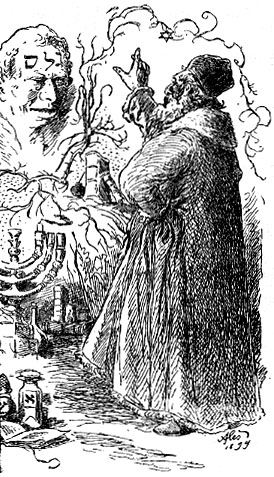
Mikoláš Aleš

Golemist


Starting Equipment: Notebook, dagger, set of brushes and inks, roll on your favorite random item list.


Perk: You can block out any external stimuli that would cause you to lose concentration on your work.
Downside: Any HP you use to create a golem can’t be regenerated by any means until that golem is dismissed.

For every Golemist template you have, gain +2 HP

A: Dismissal, Animate Lesser Golem
B: Understanding, Animate Common Golem
C: Usurp Command, Esoteric Material
D: Efficiency, Animate Greater Golem

To create a golem, you touch an object and invest a portion of your body and soul, in the form of HP. Each golem type has different HP requirements from you. I.e., you cut yourself for 1 HP and invest it into making a lesser golem. That golem has 1 HP, and you can’t regain that 1 HP until the golem is dismissed. Golems are brought to life by an arcane word inscribed in blood on their bodies somewhere. If this word is marred or erased, the golem is destroyed.

You start off being able to make clay or mud golems.

Universal Studios

Dismissal
You can instantly dismiss any golems you control with a thought, rendering them insensate matter once more. Greater golems get a save, while rogue golems have to be manually erased.

Animate Minor Golem
Spend 1 HP per golem HP to imbue a material or conglomerate of material with a portion of soul and the semblance of life. They can only follow simple commands (“Go for their legs”, “Protect this doorway”). Lesser golems are smaller than a human. Each HP you spend is one golem HP.

Understanding
You study something at a fundamental level, and gain an insight to it unrivalled in the field. Takes 1 hour of uninterrupted extrospection (30 minutes with proper equipment like a 10 gp microscope) on a solid you can examine with your tools and hands. Save vs. forgetting what you learned while you sleep, after three successes the knowledge is permanent. While you understand something, you have advantage on identifying it in other materials, and you know the best ways to kill or neutralize it. You can also create golems out of that material from now on, and golems made of that material go rogue 5% less.

Animate Common Golem
Cost 2 HP per golem HD. Your golems can be bigger (human to ogre sized), and more complex. They follow fairly complex or sequential commands.

Usurp Command
If you meet another golemist on your road, kill him and take his golems. You can impose your will over other constructs. Their controller gets a contest (or the golem does do, if it’s controller is dead). On a fail, take 1d6 psychic damage, and all your currently active golems are dismissed.

Esoteric Understanding
Your golems are stranger, utterly unique. You can use your gift of understanding on even stranger or more complicated things, like radium, air, ideas, or anti-matter. Up to GM discretion. Normal material understanding no longer needs a save vs. forgetting. Reduces all rogue chances by 5%. Stacks with understanding.

Efficiency
You bypass the Golem-Master Bond problem, allowing you to regain half the HP you invest when you create any golem. The HP is still drained, but you can regain half (rounded down) while the golem is still active.

Animate Greater Golem
Invest 3 HP per greater golem HD. These creations are thinking, sapient. Act as a hireling that is utterly devoted to you. See below on greater golem building.

Saddleback. Allows the golem to be ridden like a horse or riding lizard or whatever creature you want. Moves like an elephant. Costs 3 HP during creation.
Gun Barrel. Your golem can shoot cannon balls for 4d6 damage on a hit. Costs 6 HP, and you need a cannon on hand (or enough raw material to make one, I guess.)
Many-Legged. Your golem has more than two legs, possibly far too many. It cannot be knocked over. Costs 3 HP.
Amorphous. The whole thing is made of wet clay, living flesh, protoplasm, or other gooey substance. It can be cut in half and survive, and eventually reconstitute itself. Costs 6 HP.

Shell. The golem is hollow, with a space inside for you, the creator. Basically a mech suit, gives you the physical stats of the golem and AC like plate. Costs 6 HP.

Bladed. Covered in metal teeth, shards of glass, actual swords, sharpened bits of bone, planes of refined entropy. Does 2d6 damage on contact, really good at grappling. Costs 3 HP.

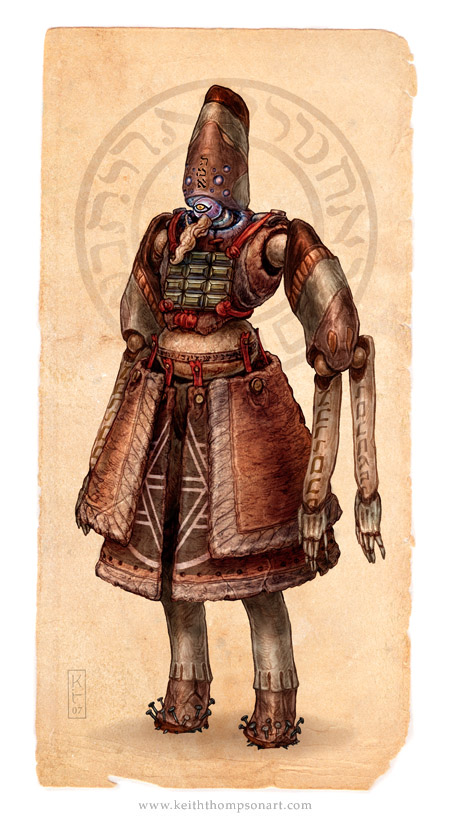
Keith Thompson

Rogue Golems
Creating a golem is a difficult undertaking. The more complex the mind, the more likely the golem is to break free of your mental restraints and act on its own initiative. This is known as “going rogue”. Whenever you create a golem and the first time you ask it to put itself in harm’s way for you, roll 1d100.

Lesser golems: 10% chance of going rogue
Common golems: 20% chance of going rogue
Greater golems: 45% chance of going rogue

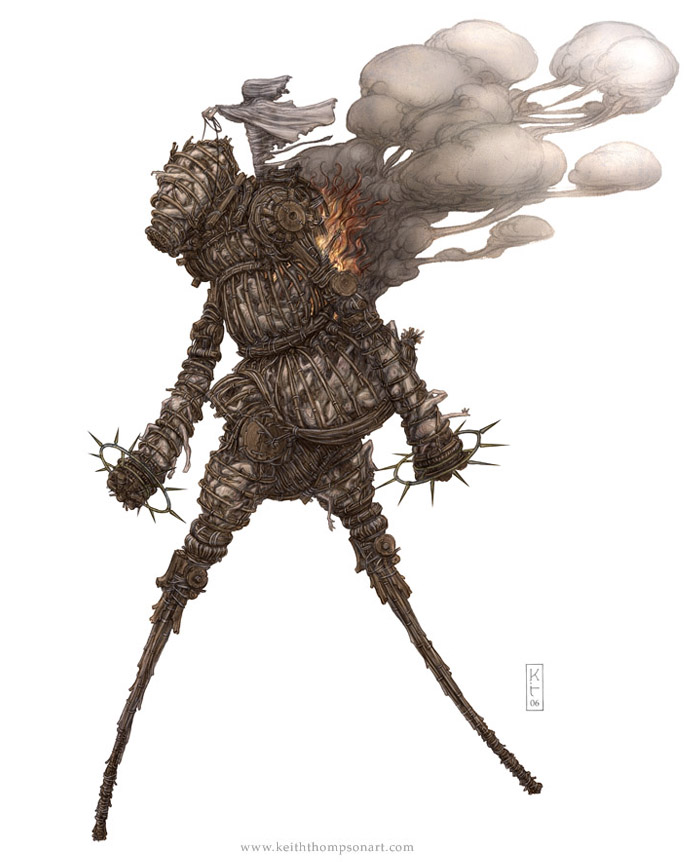
Keith Thompson, again
A Few Example Golems
Here are some golems statted up so you can see what they do and how to model them in your games.

Scissor Golems. 2 HP. AC as rat. Tries to cut your tendons or stab your feet for 1d4 damage. MOV as rat. MORALE 20. Flock like piranha. They don’t do much damage if you’re wearing good boots, but god help you if you trip and fall.
Door Golem. 3 HD. AC as Plate. Can’t really attack, but will slam itself shut on your fingers if it has to, 1d4 damage. MOV 0. MORALE 20. Used as guardians, like sphinxes. If you answer the riddle correctly or know the secret password, the way is opened for you. Forgetful mages tend to include hints to their passcodes.
Clay Golem. 1 HD. AC as Leather. Pummels you with rock-like fists for 1d6 damage. MOV as human. MORALE 20. Stolid, dependable, unoriginal. Look for the secret word on its forehead or in its mouth. 
Ball-of-Flesh Golem. 2 HD. AC as unarmored human. Rolls over you, slashing at you with random appendages for 1d6 damage. 50% chance of trying to suffocate you and add you to its mass. MOV as horse. MORALE 20. When most people see a bunch of strewn bodies, they see carnage. You see raw material.
Oliphaunt Golem. 6 HD. AC as Plate. Hits like a fucking tank, tusk-blades do 1d8 slashing while the gun in place of its head shoots for 4d6 damage. MOV as elephant. MORALE 20. Not only is it huge and dangerous, it is cunning, and seeks only to aid its creator.
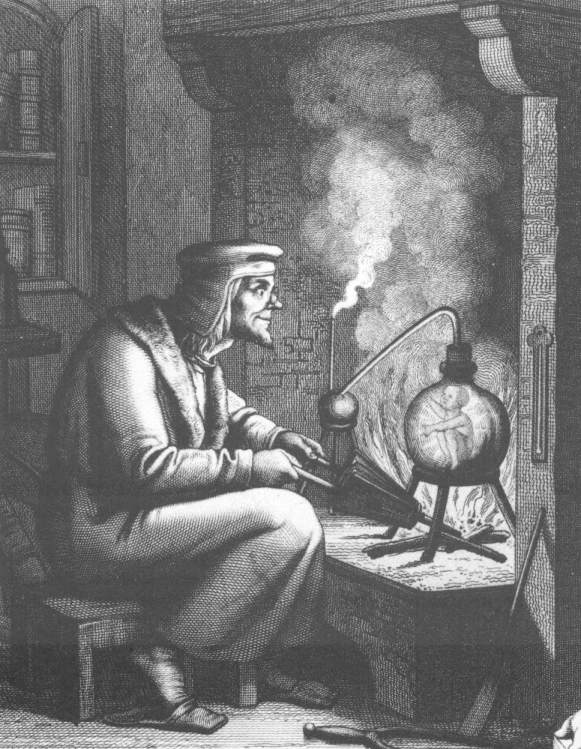
Artist unknown, from Goethe's Faust

What Your Golem Does When It Goes Rogue

  1. Attacks everything in sight, including inanimate objects. 
  2. Attacks only you, then leaves out the nearest exit.
  3. Screams without lungs or vocal chords, then collapses back into whatever original matter it was constructed from.
  4. Obeys your commands a millisecond slow, then sneaks away at its first opportunity.
  5. Walks in a counterclockwise spiral until it hits an object, then reverses around it.
  6. Begins eating everything it can fit in its mouth. If it doesn’t have a mouth, it just mashes the things on its face. The objects aren’t actually eaten; they’re still inside it, crushed and covered in clay.
  7. Attacks everything but you.
  8. Carries you to the next room/building/clearing/area then collapses.
  9. Is entirely unresponsive.
  10. Moves at one quarter of its normal rate; every attack is telegraphed so far in advance anyone can get out of their way.
  11. Constantly emits noise/smoke/sparks, thwarting any attempts at stealth or polite conversation.
  12. Walks backward, trips on everything.
  13. Obeys only the most simple and direct orders. Like playing a text-based game. Even “Go through the door” will cause it to overheat and lock in place.
  14. Whatever it wants. It is now an NPC. It remembers everything you’ve done to it, including while it was the base material.
  15. Shadows your every move, obeys none of your commands.
  16. Begins scratching every word and discernable noise it has heard on the wall/floor in dictation.
  17. Does the literal opposite of all of your commands.
  18. Uses whatever appendage is able to smash out its own word, crippling or killing itself.
  19. Gets visibly hot, then explodes for 6d6 damage.
  20. Transmutes to a new substance, then discorporates.


March 13, 2019

8 Strange Diseases, or Curses

Most scholars agree that curses and the myriad illnesses that plague humankind are one in the same, and that previous theories of predatory animals too small to see or vaporous miasmas are laughably inaccurate. A witch might curse you with a haunted reflection, or the common cold. Most cure disease spells, if pumped up with juice, will work on curses, although you have to know the effects of the curse inside and out to affect it, and that's generally hard to do, due to them not coming with instruction manuals.

That being said, here are 8 diseases that are fairly common and understood. Not to say that everyone knows how to prevent TVS, but a city doctor or priest can certainly be paid to help facilitate curing it.

1. Lobster-Dick. Your genitals become replaced with a lobster tail, complete with shell, tiny legs, and all the accoutrements. It's still functional. Gain a +1 bonus to save vs. groin attacks. If you have intercourse with someone (regardless of your sex or theirs) they become pregnant, and give birth to 1d6 lobster-men. Interestingly, this curse can be used on other body parts, but to less drastic effect (gaining a giant pincer is cool, and most adventurers can't write anyway).

How did you get it? Defiling the temple of a sea-god, or doing something truly reprehensible to a lobster. You fucking sicko.

How do you cure it? You can't. Sorry.


2. Spell Syphilis. Your mind begins to slip, and your spell slots rot right out of your head. Eventually, you die, but in the meantime you go crazy and become a stereotypical "mad wizard". Your aura, if viewed through a shew-stone or a spell like second sight, looks like a ratty old cloak made of bacteria or fungus, and you look like a living corpse. Spell slots rot at rate of 1 per day, then you start taking Wisdom damage. At 0 you die.

How did you get it? Handling any strange wands, especially those found in a dungeon.

How do you cure it? It's incurable, but you can stave off the effects by passing it on to someone else, a la It Follows.


3. Excessive Sanguinity. You have too much blood! For the first few days after contracting this illness you feel fucking great, and gain +2 to Dexterity and Strength checks, but then it starts to hurt as your veins swell and fill, with no extra space to grow to. After nearly two weeks of excrutiating agony, you pop. In that time, any being that feeds on blood (vampires, blood mages, mosquitoes) within a five mile radius knows exactly where you are.

How did you get it? Eating too many blood oranges, coming into contact with any bodily fluid already infected.

How do you cure it? Drain your blood to keep it in equilibrium, forever.


4. Spontaneous Osteo-Liquefaction. Your bones turn to liquid, usually in stages. First, the teeth liquefy and trickle down the back of the throat. Save vs choking. Then the extremities, the fingers, toes, and fontanelle, and you stop being able to hold things. Finally the main structural bones turn to liquid and you can't stand, or move quickly at all. You become a slime, of sorts.

How did you get it? Ingest the flesh of an ooze. It's a bit like lycanthropy, but grosser.

How do you cure it? Drink a bunch of milk. Bathe in milk. Sacrifice a finger to the calcium gods.


5. Scabification. Your blood begins to harden in your veins. It's slow enough that you definitely feel it, though not exactly what it is exactly. Something like arthritis or old knees, but it can affect a person of any age. Suffer a -5 penalty to all Dexterity checks. Eventually, your entire body becomes a rough, coagulated sculpture.

How did you get it? Picked too many scabs, or you didn't offer fealty to the minor spirits of bloodlust as you pass a battlefield.

How do you cure it? Drink a tincture of ground leeches and heparin, once a day for a week. The medicine makes you feel weak; -3 to your Constitution score until you stop taking it, and your save vs. poison is reduced.


6. Loss of Ontological Cohesion. Somehow, you or your body was convinced that it isn't really a human body. Your organs and tissues forget their purpose, turning into leaves and flowers and tadpoles and threads. You drift apart, your mind unravelling as your body does. Occasionally, you can remember who your were with enough fortitude so as to hold your new body together (like living armor) but this is rare. All of your physical stats begin to decrease as your body fades, and unless you pass a Wisdom save every day, so too does your mind.

How did you get it? Encountered a memetic virus, and Outsider or god thought about you too hard, or you got drunk and started talking philosophy.

How do you cure it? It can't be reversed, but you can halt it by reading anatomy textbooks and remembering bits of your past life.


7. TVS. Aka Terminal Velocity Syndrome. Once thought to be a combination of a vestibular issue and osteogenesis imperfecta, sufferers of TVS are affected by gravity at an abnormal rate. Every movement is compounded enough to instantly reach terminal velocity; even a fall from a foot or two up can be fatal. A stumble deals 1d6 damage, and all fall damage is multiplied by 5. Your attacks are a lot heavier, though, and deal +2 damage.

How did you get it? Struck on the head by a Stygian apple, or bitten by a gravity goblin.

How do you cure it? Remain suspended in an antigravity field for an hour a day.


8. Teakettler Disease. Your internal body temperature is constantly rising, causing pain and pressure on your bones. If you ignore it long enough without releasing it (roughly every three hours), you take 1d6 exploding heat damage. When you release it, it issues from your mouth in a burst of steam and a piercing whistle that can be heard from far away. Your sleep is rough and unsteady, and you gain 1/2 the XP you normally would.

How did you get it? You didn't offer a weary guest the customary drink, or touched a dragon's scale without washing it in grain alcohol first.

How do you cure it? Consume a cumulative 9 pounds of ice.