Showing posts with label osr. Show all posts

October 20, 2019

Nuclear Ooze

I finished the first draft of my gloghack, Nuclear Ooze! Finished is a strong word, I guess. I looked through it again after I published the pdf, and noticed a bunch of wonking formatting, weird choices, and wording issues that I can't be bothered to go back through right now. Next time, I'll fix it.

It's primarily frankensteined together from Arnold K's original rules, Skerple's Rat on a Stick, Meandering Banter's Die Trying, and Cratered Land's Mimics and Miscreants, although there are a lot of influences (read: things I've mercilessly stolen and ripped from other games).

>>Get Nuclear Ooze Here<<

Tell me what you think, especially if you use it!

Here's a bonus race, because I haven't posted any actual gameplay related stuff in a while.


Dunkleostans
Bipedal jungle fish-people. Long, single-finned tails and stubby legs like newt's limbs. The tail is thick with corded muscle, wide as two human thighs. Their heads are large and covered in thick plates of bone; two beady eyes stare out pugnaciously above a wide mouth lined with two razor-sharp ridges of bone, able to shear straight through a spear's haft.

They are unwieldy on land; they propel themselves through the water with powerful motions of that huge tail and catch prey like riversquid and the bastard dolphins that move in the silty water. A bonefish kraal is made of padded, clay-thick mud, woven with water reeds and bamboo beneath the surface. They sleep in the mud, gills gently moving and bubbling through the surface.

Despite their fearsome appearance, they are quite friendly with traders and other denizens of the Hundred Rivers Valley. They usually choose to remain in conclaves with other bonefish families, although a few of their number go to Larothe or any of the other Lake Cities to make a life in the newly-burgeoning modern, industrialized world.

Perk: Your head always is considered armored. +1 AC or AP or whatever system you use, ignore most head wounds.
Downside: You must return to the water (or at least a wet bank of mud) to sleep every night, or you'll start to suffocate.
Stat Reroll: Strength


September 28, 2019

Lunar Vampires

The Moon is dead, but there is life on and in it. Deep under the surface where the polyp-trees stretch their paralyzed branches and release reified madness in mercury drops to the sky, beneath the caverns and hollows made when the ground shifted and made room for lunar slugs and beetle-bears, there are deposits of a strange, hard material like ceramic but somehow more pliable. This is where the dead lie, the terrible secrets of eons past that have been buried under ash and layers of strange decay.

The deposits, if you were to exhume them (and exhuming them is what it would be, for you would be digging up tombs and coffins), would be ovoid, like squashed spheres of white plastic. Sometimes they'd have crushed and bent articulated legs. There are doorways and openings. They are huge, a few more than a mile across. You'd see the tracks they dig through the strata as they so slowly gravitate towards each others, at a geological pace. They grow into each other like mitosis in reverse. Inside, they are dark, deactivated, fractal, and incomprehensible. They each served myriad purposes, once.

This is the main arena of dungeon-delving on the Moon. Or at least the most ripe for plunder; a latticeman doesn't have much to offer adventurers than a pile of slimy spacesuits and some rotted bones. But the vampire catacombs are jam-packed: filled with strange equipment, surgical labs, esoteric weapons, and of course, vampires.

Lunar vampires aren't stereotypical eastern European counts. In fact, they look like slightly-shriveled, dead versions of your friends. Sometimes literally. There's a 25% chance that one of the vampires you fight or interact with is a doppelganger of someone you know. There's a 1% chance it looks like you. They actually come from a different version or timeline of the Moon and Earth. It doesn't really matter; they're stuck here now, just like you. They look utterly human externally, but they wear strange elastic jumpsuits, and arcane bits of machinery cover them occasionally. They look like extras from a 60s-70s scifi television show, and their tombs are built to match, all formica and plastic and curves.

Their bones are black carbon, scintillating with strange elements. Their blood is thick and greenish, more like sap than blood. It carries the vampiric germ; anyone who drinks it, or is fed it, or is injected with it in one of the ancient surgical machines will become a thrall-vampire in 1 week, unless their blood is cleansed before that. Vampires have blunt, human teeth. Biting does the same damage as a human does, unless they use tongue. Their tongues are coated in microscopic saw teeth that rip flesh with horrifying ease, and they use these terrible appendages like sponges to soak up blood. They are inhumanly strong, and magnificently hard to kill. Vampire wars were once fought with vibroblades and sonic canons that could disassemble you at a molecular level.

They once created a race of Renfields out of conquered people, enslaved on their millenia-long conquest of the universe. The DNA slurried and combined and restructured, extruded and recombined with more and more victims. Slowly creating the space ghouls that now wander these white, darkened corridors, maintaining the slow workings of their kidnapper-masters. Renfields are diminutive, like hunched men. Their translucent flesh displays their glasslike bones and pumping lymph. (The vampires removed the Renfields' need for blood so as to not eat their own slaves.) Renfields won't harm adventurers, prefering to lure them into traps or their sleeping masters.

***

Vibroblade
Extremely sharp. Does 1d8+1 damage. Has 50 charges in its tenebrovoltaic battery. Using one charge activates the vibration motor, causing an additional 1d8 of damage, sawing through limbs like butter and leaving heavily bleeding, ragged stumps.

Molecular Disassembly Canon
A mass of tubes and wires with a series of Nixie tube-like glass bells underneath, filled with Sonic Ooze. Must be fed blood weekly, or the ooze dies. Firing it causes an electric shock to agitate the oozes, which send out a metasonic vibration through the tubes. Does d12 damage, exploding on a 1 or 12.

***

Lunar Vampire
HD 3 ATK 12 DEF as leather MV 16’, 6’ fly once per day Tongue 2d6 Bite or Weapon 1d6/1d6 Save 8 Int 10, 15 if recently fed Morale 4
Emaciated, near-feral, and weak. Shadows of the dread cosmic vampires they once spawned from. Crave blood all the time, made mad by their hunger. Must be decapitated, have their hearts ripped out or staked, or be burned. Want to eat flesh and regain their opulence.
Vampiric: Regains 1d4 hp whenever it drinks blood.

Rose-Devil
HD 2 ATK 14 DEF as leather MV 18’ Thorns 1d6 Tendrils 1d6/1d6 Save 8 Int 16 Morale 3
Ancient vampires whose flesh has finally dissolved away from hunger. Bendy and thorned. Heads look like skulls made of wicker mixed with rose blossoms. They bathe in blood to grow back flesh. Can only be burned, or utterly dismembered. Want to become whole again.
Regeneration: When bled on, gain 1 hp.

Renfield
HD 1 ATK 10 DEF unarmored MV 12' Bite 1d4 Save 6 Int 8 Morale 6
Translucent, jellylike. Born from vats in the cellships, reconstituted collected biomass. They eat flesh too, but don't hunt; they'll eat whatever's left after their masters finish. Want to faithfully serve the vampires.
Translucent: Advantage on stealth rolls while in dim light or darkness.

September 26, 2019

Dwarves and Orichalcum

The old dwarf across from you in the cramped booth hacks and spits and laughs, his craggy face marred with evenly-spaced scarification, his wide teeth black and coated in rasps. His lips are red with dripped rust. Eyes bulging and thick with veins like knots of twine. He leans forward and swigs from the mug of alcohol you procured for him, stuff used for sterilizing medical equipment, laced with belladonna and morphine.

“Sure, I can show you into ol’ Mound 378. I can even get you to the tomb-forges outside her jurisdiction. But I’ll need something more encouraging than this tepid shit.” He swirls the mug for emphasis. His words seem hollow, the human dialect alien to his tongue even after all these years exiled from his kind. The singular pronouns especially strike dull from his mouth.

He drinks the rest of the booze in one gulp, then sighs. A wind like that off of a rusted scrapyard blows across your face.

You ask him his price.

Another harsh laugh. He fingers the scars up and down his face. “A trice more than you can afford, deary.” He quiets and thinks for a moment. The levity falls from his face like a dropped mask.

“On further reflection, maybe I can get you in. But you’ll have to do me a favor or three...”

***

Many people have written about the Folk Underneath. I’m not the first, nor will I be the last. My account is not comprehensive, but it is more accurate than others. Those “scholars” have studied the dwerro from afar, using unsubstantiated reports from drug-addled silk merchants and half-dead adventurers. They say that dwarves are living golems (a ridiculous prospect, since any golemist worth their salt know that golems exemplify unlife). Others claim they are born spontaneously from the rock, or were shaped from it by a god. That dwarves are magical mole-people who can grab anyone at any time. That they are little men who enjoy engineering and alcohol. That dwarves are a branch of humanity, like Neanderthals or the mooncalf quadrupeds that the halflings of the Bhyru Plains cultivate and ride. That dwarves don't exist.

These claims are ridiculous.

(Although the Hermit of Mount Whimsy got it pretty close)

They grew deep in the earth, from life much different than that of the surface. Their flesh provides no nutrition for predators of the surface. A beast may starve to death with a belly full of dwarf.

They eat metal. Their skills as miners and engineers come from necessity, the same way early humanity became hunters and gatherers. Dwarvish cuisine is boles of wires and slabs of foil in divergent hues, layers of brass and silver and iron with heavy corners. Supplemented with bacterial mats and fungal blooms and huge eyeless fish. They consume the empty calories to extract the rare trace metals in them, like vitamins.

Common folk think there are three types of dwarf. White Dwarves, impetuous and quick, Black Dwarves, stolid and reliable, and Red Dwarves, slow and thoughtful. These are actually just the stages of dwarvish life. They start off pale and alabaster-white like milky babies. Their flesh cleaves, not tears. The metal a dwarf eats begins to stain their skin and muscles with molecules of iron and bismuth, gold and aluminum. They turn shiny and gunmetal grey. Eventually their metabolism slows down and the metal suffusing their flesh rusts, turning their skins rich russet hues.

Each person in a dwarf city is a cog or wheel in a greater machine, working together for the betterment of the community at the detriment of anything else. The concept of communism sprung forth from the savant minds of dwarven leaders. They work together intrinsically, nascent fixation on community like underground honeybees of alien flesh. They don’t understand philosophy, individualism, and religion is regarded as a thoughtvirus, punishable by jailtime or even mutilation. Their god is the great god Efficiency, blind and dumb.

Each city is governed by a conclave of 188 councilors or ministers who dictate each aspect of life. Thoughtcrime, neuro-atypical dwarves, seditionists, and possible demiurges are exiled, stricken from dwarvish thought, scarred with the parallel mark that lets all dwarves know this one has been made undwarf. They regard the exiles as humans, or at best thick halflings. Exiled dwarves make up most of the "adventurer" dwarves of the surface, but sometimes truethread dwarves come up and act as if they were exiled, deep-cover operatives to jealously guards the autonomy of dwarfdom.

Dwarves don’t take baths, because their biology fights off what germs their high-proof liquor doesn’t kill. It isn’t efficient to waste time cleaning yourself when there’s work to be done. They’re also terrified of water, because their skeletons are made of metal.

A strange reaction occurs within the gut of a dwarf. The minerals they eat dissolve and discorporate into molecules, which suffuse their body. Over time, the molecules settle and join with the fractal hooks and spurs of the dwarvish skeleton, forming crystal-laticed structures of alloyed metal. Quicksilver joins to lead, lead joins to gold, gold joins to iron, forming a new material found nowhere else naturally on earth. Refined and worked, it is stronger than steel, lighter than aluminum, more powerful than uranium. Orichalcum.

Dwarves use orichalcum in everything they make. Weapons, work-machines, architecture. A bar of orichalcum is worth a small kingdom on the surface, and many a would-be thief has met their end at the brutally efficient defenses of the mound-cities. They will wait a century or two until all the flesh has fallen off of the bones of a fallen dwarf, then smelt them into raw material to be reused later.

“That’s a really nice warhammer.”

“Thanks, it was my grandfather.”

***

If you’re a dwarf in a GLOG campaign, use these stats when rolling your character:

Perk: you can eat metal along with rations to gain health. The type of metal corresponds with the ration; eating 5 copper is the same as 1 ration, while 1 gp is like a feast. You can’t suffer heavy metal poisoning.

Downside: your skeleton is metal. You’re much heavier than you look. People trying to lift you suffer a -2 penalty, and you sink immediately in water. Those who know about the secrets of orichalcum might try to murder you for your valuable bones.

Rerolled Stat: Strength

Anyway, it's taken me like 2 weeks to write this. Couldn't get it to sound right, and I'm still not sure it does. I'll link the other GLOG writers who've made awesome dwarves once I can find their pages.

March 27, 2019

The Golemist (GLOG Class)

In the rain-soaked city of Ischaim, cloistered scholars and rabbis perform sacred rites and incantations over holy simulacra of men, designed to impart life and stewardship into these guardians of the faithful. You are not a holy man, or one of the faithful. The secrets of golemistry were leaked to the arcane public, losing the trappings of religion in the process. Now golemistry is utilized by most major countries, and wandering golemists fill secretive clubs and barrooms with hulking clay bodies, glimmering in the firelight.


This class was inspired by a lot, notably Judah Low from Iron Council and the State Alchemists of FMA. I wanted something like a summoner class that drew upon their surroundings for quick minion creation in combat. It’s kinda like a spellcaster if they only had one spell that got more specific as they levelled up. I’m not sure it’ll work, since I haven’t really tested it, but it was fun to write. Maybe in time, after some testing, I’ll give it another writeup and spruce it up (but probably not).


I wrote it as a competition with Spwack over in the OSR discord. Check out his Golemist class (I have no doubt his actually works) and his other stuff, it’s all very good and weird. I've never written a GLOG class before, so this was a really fun way of getting into things!

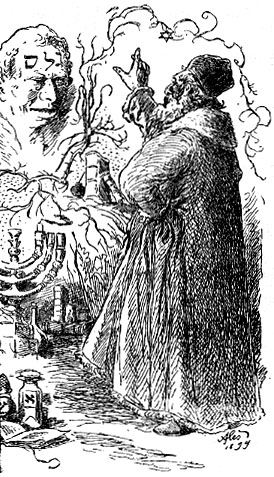
Mikoláš Aleš

Golemist


Starting Equipment: Notebook, dagger, set of brushes and inks, roll on your favorite random item list.


Perk: You can block out any external stimuli that would cause you to lose concentration on your work.
Downside: Any HP you use to create a golem can’t be regenerated by any means until that golem is dismissed.

For every Golemist template you have, gain +2 HP

A: Dismissal, Animate Lesser Golem
B: Understanding, Animate Common Golem
C: Usurp Command, Esoteric Material
D: Efficiency, Animate Greater Golem

To create a golem, you touch an object and invest a portion of your body and soul, in the form of HP. Each golem type has different HP requirements from you. I.e., you cut yourself for 1 HP and invest it into making a lesser golem. That golem has 1 HP, and you can’t regain that 1 HP until the golem is dismissed. Golems are brought to life by an arcane word inscribed in blood on their bodies somewhere. If this word is marred or erased, the golem is destroyed.

You start off being able to make clay or mud golems.

Universal Studios

Dismissal
You can instantly dismiss any golems you control with a thought, rendering them insensate matter once more. Greater golems get a save, while rogue golems have to be manually erased.

Animate Minor Golem
Spend 1 HP per golem HP to imbue a material or conglomerate of material with a portion of soul and the semblance of life. They can only follow simple commands (“Go for their legs”, “Protect this doorway”). Lesser golems are smaller than a human. Each HP you spend is one golem HP.

Understanding
You study something at a fundamental level, and gain an insight to it unrivalled in the field. Takes 1 hour of uninterrupted extrospection (30 minutes with proper equipment like a 10 gp microscope) on a solid you can examine with your tools and hands. Save vs. forgetting what you learned while you sleep, after three successes the knowledge is permanent. While you understand something, you have advantage on identifying it in other materials, and you know the best ways to kill or neutralize it. You can also create golems out of that material from now on, and golems made of that material go rogue 5% less.

Animate Common Golem
Cost 2 HP per golem HD. Your golems can be bigger (human to ogre sized), and more complex. They follow fairly complex or sequential commands.

Usurp Command
If you meet another golemist on your road, kill him and take his golems. You can impose your will over other constructs. Their controller gets a contest (or the golem does do, if it’s controller is dead). On a fail, take 1d6 psychic damage, and all your currently active golems are dismissed.

Esoteric Understanding
Your golems are stranger, utterly unique. You can use your gift of understanding on even stranger or more complicated things, like radium, air, ideas, or anti-matter. Up to GM discretion. Normal material understanding no longer needs a save vs. forgetting. Reduces all rogue chances by 5%. Stacks with understanding.

Efficiency
You bypass the Golem-Master Bond problem, allowing you to regain half the HP you invest when you create any golem. The HP is still drained, but you can regain half (rounded down) while the golem is still active.

Animate Greater Golem
Invest 3 HP per greater golem HD. These creations are thinking, sapient. Act as a hireling that is utterly devoted to you. See below on greater golem building.

Saddleback. Allows the golem to be ridden like a horse or riding lizard or whatever creature you want. Moves like an elephant. Costs 3 HP during creation.
Gun Barrel. Your golem can shoot cannon balls for 4d6 damage on a hit. Costs 6 HP, and you need a cannon on hand (or enough raw material to make one, I guess.)
Many-Legged. Your golem has more than two legs, possibly far too many. It cannot be knocked over. Costs 3 HP.
Amorphous. The whole thing is made of wet clay, living flesh, protoplasm, or other gooey substance. It can be cut in half and survive, and eventually reconstitute itself. Costs 6 HP.

Shell. The golem is hollow, with a space inside for you, the creator. Basically a mech suit, gives you the physical stats of the golem and AC like plate. Costs 6 HP.

Bladed. Covered in metal teeth, shards of glass, actual swords, sharpened bits of bone, planes of refined entropy. Does 2d6 damage on contact, really good at grappling. Costs 3 HP.

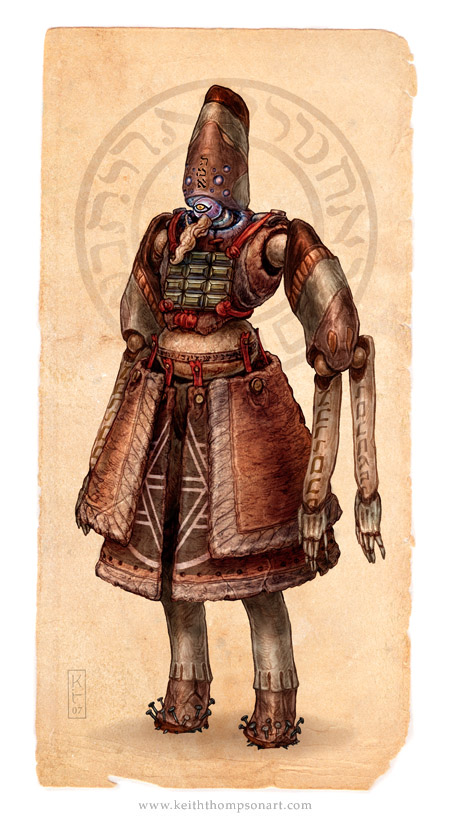
Keith Thompson

Rogue Golems
Creating a golem is a difficult undertaking. The more complex the mind, the more likely the golem is to break free of your mental restraints and act on its own initiative. This is known as “going rogue”. Whenever you create a golem and the first time you ask it to put itself in harm’s way for you, roll 1d100.

Lesser golems: 10% chance of going rogue
Common golems: 20% chance of going rogue
Greater golems: 45% chance of going rogue

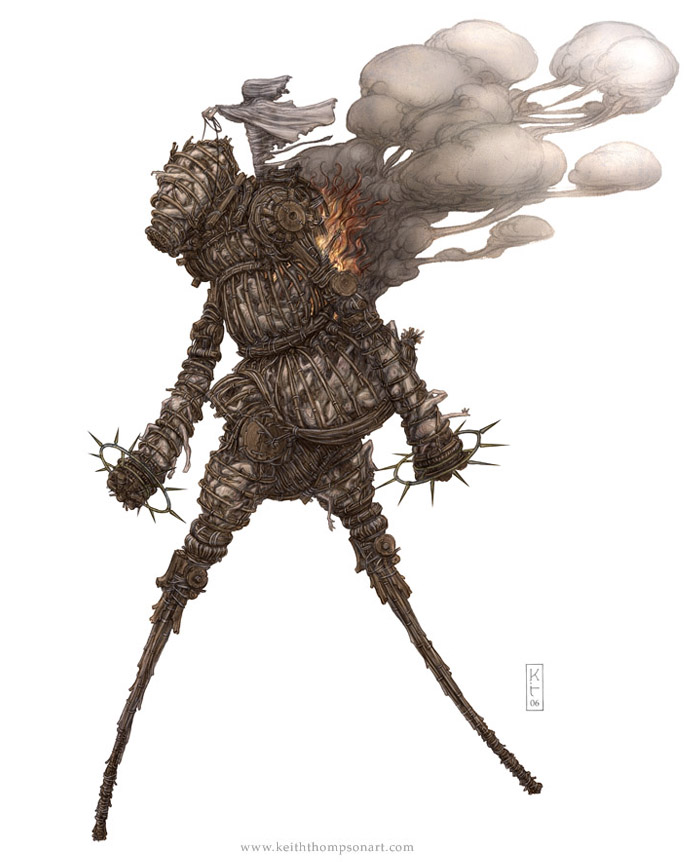
Keith Thompson, again
A Few Example Golems
Here are some golems statted up so you can see what they do and how to model them in your games.

Scissor Golems. 2 HP. AC as rat. Tries to cut your tendons or stab your feet for 1d4 damage. MOV as rat. MORALE 20. Flock like piranha. They don’t do much damage if you’re wearing good boots, but god help you if you trip and fall.
Door Golem. 3 HD. AC as Plate. Can’t really attack, but will slam itself shut on your fingers if it has to, 1d4 damage. MOV 0. MORALE 20. Used as guardians, like sphinxes. If you answer the riddle correctly or know the secret password, the way is opened for you. Forgetful mages tend to include hints to their passcodes.
Clay Golem. 1 HD. AC as Leather. Pummels you with rock-like fists for 1d6 damage. MOV as human. MORALE 20. Stolid, dependable, unoriginal. Look for the secret word on its forehead or in its mouth. 
Ball-of-Flesh Golem. 2 HD. AC as unarmored human. Rolls over you, slashing at you with random appendages for 1d6 damage. 50% chance of trying to suffocate you and add you to its mass. MOV as horse. MORALE 20. When most people see a bunch of strewn bodies, they see carnage. You see raw material.
Oliphaunt Golem. 6 HD. AC as Plate. Hits like a fucking tank, tusk-blades do 1d8 slashing while the gun in place of its head shoots for 4d6 damage. MOV as elephant. MORALE 20. Not only is it huge and dangerous, it is cunning, and seeks only to aid its creator.
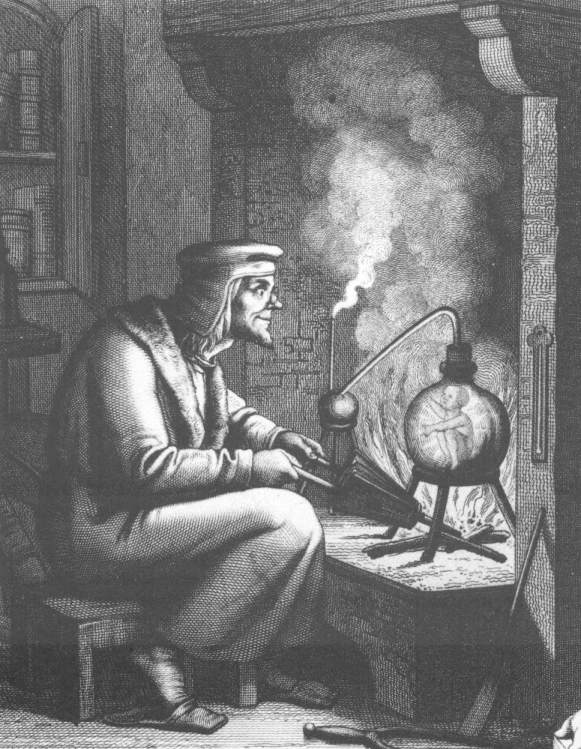
Artist unknown, from Goethe's Faust

What Your Golem Does When It Goes Rogue

  1. Attacks everything in sight, including inanimate objects. 
  2. Attacks only you, then leaves out the nearest exit.
  3. Screams without lungs or vocal chords, then collapses back into whatever original matter it was constructed from.
  4. Obeys your commands a millisecond slow, then sneaks away at its first opportunity.
  5. Walks in a counterclockwise spiral until it hits an object, then reverses around it.
  6. Begins eating everything it can fit in its mouth. If it doesn’t have a mouth, it just mashes the things on its face. The objects aren’t actually eaten; they’re still inside it, crushed and covered in clay.
  7. Attacks everything but you.
  8. Carries you to the next room/building/clearing/area then collapses.
  9. Is entirely unresponsive.
  10. Moves at one quarter of its normal rate; every attack is telegraphed so far in advance anyone can get out of their way.
  11. Constantly emits noise/smoke/sparks, thwarting any attempts at stealth or polite conversation.
  12. Walks backward, trips on everything.
  13. Obeys only the most simple and direct orders. Like playing a text-based game. Even “Go through the door” will cause it to overheat and lock in place.
  14. Whatever it wants. It is now an NPC. It remembers everything you’ve done to it, including while it was the base material.
  15. Shadows your every move, obeys none of your commands.
  16. Begins scratching every word and discernable noise it has heard on the wall/floor in dictation.
  17. Does the literal opposite of all of your commands.
  18. Uses whatever appendage is able to smash out its own word, crippling or killing itself.
  19. Gets visibly hot, then explodes for 6d6 damage.
  20. Transmutes to a new substance, then discorporates.


March 13, 2019

8 Strange Diseases, or Curses

Most scholars agree that curses and the myriad illnesses that plague humankind are one in the same, and that previous theories of predatory animals too small to see or vaporous miasmas are laughably inaccurate. A witch might curse you with a haunted reflection, or the common cold. Most cure disease spells, if pumped up with juice, will work on curses, although you have to know the effects of the curse inside and out to affect it, and that's generally hard to do, due to them not coming with instruction manuals.

That being said, here are 8 diseases that are fairly common and understood. Not to say that everyone knows how to prevent TVS, but a city doctor or priest can certainly be paid to help facilitate curing it.

1. Lobster-Dick. Your genitals become replaced with a lobster tail, complete with shell, tiny legs, and all the accoutrements. It's still functional. Gain a +1 bonus to save vs. groin attacks. If you have intercourse with someone (regardless of your sex or theirs) they become pregnant, and give birth to 1d6 lobster-men. Interestingly, this curse can be used on other body parts, but to less drastic effect (gaining a giant pincer is cool, and most adventurers can't write anyway).

How did you get it? Defiling the temple of a sea-god, or doing something truly reprehensible to a lobster. You fucking sicko.

How do you cure it? You can't. Sorry.


2. Spell Syphilis. Your mind begins to slip, and your spell slots rot right out of your head. Eventually, you die, but in the meantime you go crazy and become a stereotypical "mad wizard". Your aura, if viewed through a shew-stone or a spell like second sight, looks like a ratty old cloak made of bacteria or fungus, and you look like a living corpse. Spell slots rot at rate of 1 per day, then you start taking Wisdom damage. At 0 you die.

How did you get it? Handling any strange wands, especially those found in a dungeon.

How do you cure it? It's incurable, but you can stave off the effects by passing it on to someone else, a la It Follows.


3. Excessive Sanguinity. You have too much blood! For the first few days after contracting this illness you feel fucking great, and gain +2 to Dexterity and Strength checks, but then it starts to hurt as your veins swell and fill, with no extra space to grow to. After nearly two weeks of excrutiating agony, you pop. In that time, any being that feeds on blood (vampires, blood mages, mosquitoes) within a five mile radius knows exactly where you are.

How did you get it? Eating too many blood oranges, coming into contact with any bodily fluid already infected.

How do you cure it? Drain your blood to keep it in equilibrium, forever.


4. Spontaneous Osteo-Liquefaction. Your bones turn to liquid, usually in stages. First, the teeth liquefy and trickle down the back of the throat. Save vs choking. Then the extremities, the fingers, toes, and fontanelle, and you stop being able to hold things. Finally the main structural bones turn to liquid and you can't stand, or move quickly at all. You become a slime, of sorts.

How did you get it? Ingest the flesh of an ooze. It's a bit like lycanthropy, but grosser.

How do you cure it? Drink a bunch of milk. Bathe in milk. Sacrifice a finger to the calcium gods.


5. Scabification. Your blood begins to harden in your veins. It's slow enough that you definitely feel it, though not exactly what it is exactly. Something like arthritis or old knees, but it can affect a person of any age. Suffer a -5 penalty to all Dexterity checks. Eventually, your entire body becomes a rough, coagulated sculpture.

How did you get it? Picked too many scabs, or you didn't offer fealty to the minor spirits of bloodlust as you pass a battlefield.

How do you cure it? Drink a tincture of ground leeches and heparin, once a day for a week. The medicine makes you feel weak; -3 to your Constitution score until you stop taking it, and your save vs. poison is reduced.


6. Loss of Ontological Cohesion. Somehow, you or your body was convinced that it isn't really a human body. Your organs and tissues forget their purpose, turning into leaves and flowers and tadpoles and threads. You drift apart, your mind unravelling as your body does. Occasionally, you can remember who your were with enough fortitude so as to hold your new body together (like living armor) but this is rare. All of your physical stats begin to decrease as your body fades, and unless you pass a Wisdom save every day, so too does your mind.

How did you get it? Encountered a memetic virus, and Outsider or god thought about you too hard, or you got drunk and started talking philosophy.

How do you cure it? It can't be reversed, but you can halt it by reading anatomy textbooks and remembering bits of your past life.


7. TVS. Aka Terminal Velocity Syndrome. Once thought to be a combination of a vestibular issue and osteogenesis imperfecta, sufferers of TVS are affected by gravity at an abnormal rate. Every movement is compounded enough to instantly reach terminal velocity; even a fall from a foot or two up can be fatal. A stumble deals 1d6 damage, and all fall damage is multiplied by 5. Your attacks are a lot heavier, though, and deal +2 damage.

How did you get it? Struck on the head by a Stygian apple, or bitten by a gravity goblin.

How do you cure it? Remain suspended in an antigravity field for an hour a day.


8. Teakettler Disease. Your internal body temperature is constantly rising, causing pain and pressure on your bones. If you ignore it long enough without releasing it (roughly every three hours), you take 1d6 exploding heat damage. When you release it, it issues from your mouth in a burst of steam and a piercing whistle that can be heard from far away. Your sleep is rough and unsteady, and you gain 1/2 the XP you normally would.

How did you get it? You didn't offer a weary guest the customary drink, or touched a dragon's scale without washing it in grain alcohol first.

How do you cure it? Consume a cumulative 9 pounds of ice.

March 9, 2019

Larothe, City of Moths

The city sits in the shallow basin of the Waxahatchee river valley, more a plate than a bowl, slumped and sumptuous and decaying ever so slowly into the muddy water. There are roads leading to other cities and nations, carved out of the jungle in strange almost-tunnels that the natives of the region believe to have been tracks of the Great Worm, but during the rainy season they become impassable with fallen trees and flowing water.

Creatonotos gangis. Thanks for the nightmares, Skerples.

Like an emerald, Larothe shifts in the sunlight. It's hot and humid, and gharials and jaguars lounge about the stone canalsides and arcades that are submerged half the year. Creeping vines and hardwoods and drakeblood trees cling to the tops and sides of the buildings, and wiry men and women in undyed clothes pole thin canoes called sculs to market and out in the river, which is wide and placid enough to be called a lake. But the most striking thing any newcomer notices, stinking and sweating and usually fever-eyed, are the moths.

Opodiphthera eucalypti.

Dozens, hundreds, thousands of moths. They cover the city in a shifting mosaic of life. Species from all across the known world congregate in Larothe. The grinning, twitching moth-priests scratch themselves until they bleed and smile with teeth black with rot and lacquer and say that the River Moth gathers them here because they are his children.

Thaumetopoea pityocampa.

(There are no butterflies. Swarms of normally-placid moths find them and rip them apart as soon as they get within a rough three-mile radius of the city, leaving only gently floating vibrant wingscales on the breeze.)

Laothoe populi.

The moths are the lifeblood of the Larothi. They breed hunting moths the size of footballs, rigged with razorblades on their abdomens and blinders on their compound eyes, caterpillars the size and furred-texture of bison that never pupate. They scrape them from walls and mash them into a grey paste called uir gran that is used as a protein sample in every household. Larothe fashion is dictated by moth and by tedium; the sumptuous, shimmering clothes of the rich are sewn in mandalas of moth-scales, painstakingly plucked from still-living wings in religious ceremonies. At night, huge black vampire moths use their delicate needle-claws to draw blood from sleeping people and livestock (mosquito nets are a very necessary expense in Larothe), and huge nymph-pupae swim in the murky water like antlions, their blind faces seeking flesh to rend and devour with their immense mandibles.

Thysania agrippina.

Nominally, the King of Larothe holds dominion over the city and the satellite settlements that provide maize and rice to the metropolis, but the real power lies with the moth-priests. The kings have been elected by a council of apotheosis-seeking priests since the Dawn of Dusted Sun, and the populace knows it. Religious holidays are observed without fail, and divergence is punished with exile to the inverted tower. Outsiders are exempt from these laws until they reside in the city for 10 months and 10 days.

Attacus atlas.


The River Moth

Part god, part bogeyman. The moth-priests revere and revile it, and pray that it stays away during the driest time of the year, when the river recedes and the entrance to the inverted tower is revealed and yawns like a dead mouth. Swarms of moths circle over its top day and night, and some say you can read your fortune in their gyrations. No one has seen it, but every year it appears in dreams to some in the city, who are blessed with the Mark of the Moth, vertical welts down the face. It always looks huge and dark, with too many limbs and eyes and mouths, and with four huge, fluttering wings. It has an affinity with the moon.

Chrysiridia rhipheus.

To appease the River Moth, the devout smash open the still-living skulls of capuchin monkeys and smear the brains across the lentils and frames of their doors. The Moth passes them by, but the brains must be reapplied every other night until the river rises back up to the Third Mark, and the tower is filled with water once again.

Acherontia atropos.

The truth is that the River Moth isn't real, or at least isn't a physical being. It is a shared hallucination brought on by the chemical dust that falls from the wings of the Actias rursus, a flesh-eating moth that flutters over sleeping victims. The dust has a soporific and pruritian effect on the victim; they suffer strange, feverish dreams and begin scratching at their faces and heads until they scratch through their skulls and into their brains, which the moth then eagerly drinks up. This is called the "itching illness".

Agrotis infusa.

The priests take this dust and apply small amounts to their bodies to grant them the dreams of their god, and they leave their wounds open to offer sustenance to other fluid-drinking insects. They look like junkies in living cloaks of fluttering wings.

Utetheisa ornatrix.

Things to Procure in Larothe

The people of Larothe trade and barter, or use deathshead moth wings as currency, but they'll except your silver and copper. Larothe is a crossroads, remote as it is, and you can find pretty much anything there, but here are a few things you'll need in the jungle.
  1. A scul. Holds 2 people and a small amount of gear. Goes pretty fast, and is really maneuverable.
  2. A hunting moth. Eats fresh meat, ferocious, dies in two weeks. AC as hawk, d6 razor damage.
  3. Mosquito net. Good for preventing malaria and having your brain eaten.
  4. Silkworm armor. AC as studded leather, but takes up no inventory space and breathes in the jungle heat.
  5. Grubslinger. A specialized slingshot that launches live larvae at enemies.
    • Earworm. Comes in pairs. One crawls in your ear, the other is shot at an enemy. Slowly enters the victims ear canal and takes up residence. They vibrate at the same frequencies; you can hear what the enemy hears, but their voice is subsonic and only comes through as deep rumbling.
    • Lead moth. Clings to the victim and starts gaining density, weighing down their swings.
    • Sawbird pupa. The young form of a vicious, piranha-like moth, coated in microscopic iron-hard teeth. Rotates in the air like a buzzsaw, does 3d6 damage.
    • Lipid moth. Confusing, spiralling, fractal. Too many legs and bends. It seems to dissolve into the skin and eats the fats out of the victim's body over the course of a week. Save vs wasting away, or lose 1 Con per day until you die.
  6. Hoien ul. A lamp on a ten foot pole, shines a bright, nearly-white light for 60 feet. Draws every goddamn moth in the jungle; used by priests in ceremonies for new initiates.
  7. Cocoon of the Fluttering Saint. The only mortal to attain apotheosis, the Fluttering Saint became a mixture of man and moth and flew up to live on the moon. His cocoon has been shredded, and thieves regularly sneak bits of it out. If you eat it, gain infrared vision for 1d6 hours. Save vs mutation or begin slowly dissolving into moths.

    I'll add more, but I'm tired and I need to put something new up.

    February 24, 2019

    Equipment on the Moon

    So last time I wrote, it was about the Cat's Cradle, which is the easiest and most safe way of getting to the Moon, which is really saying something. This post is about what your players might find on the Moon, or should've brought with them in the first place.

    Here you are. You've survived your trainride up the artery of the Cat's Cradle in one piece, and your train comes out into a vast, tiled room with many vaulted doors and people in bulky suits. The train belches one last bit of exhaust as the air is siphoned out of the room (to be bottled and compressed and sold as cheap oxygen tanks) and the huge doors open, the bright light of the sun cutting through the thin glow of shielded lamps along the walls. Your carriage judders as the rail's guage switches, and you're suddenly out, with a huge expanse of blackness above you and an endless plain of ash around you. You're finally on the Moon...


    Spacesuits: They aren't exactly dedicated for space; a lot of people just modify diving suits, or vice versa. Anything that keeps the pressure, temperature, and oxygen inside roughly survivable will work. Some brave souls rely on magic or Breaking, but that kinda shit doesn't always work on the Moon (1-in-4 chance for Visitor artifacts to fail). Most of them take up a lot of inventory space and make it tough to move deftly, and the ones that don't are delicate beyond belief.

    Euler Vacuum Suit
    Cost: 200 slugs, 40 minutes
    Bulky, metal, stolid. Reduces your Dexterity by 3, and every hour you spend walking wastes more of your reserves (gain a point of exhaustion, if you're playing 5e.) AC like plate. Takes up 6 inventory spaces, makes you encumbered, whatever; they fucking suck to walk in, but who wants to walk on the Moon anyway? It's weird, and cold, and haunted, and there's always a wind blowing that you can feel through your suit (its a metaphysical wind, tugging at one of your souls). Euler suits can utilize two tanks of oxygen at one time, and have slots for four more in reserve.

    Chester E. McDuffee's patented diving suit - 1911

    LeBeaux Walkabout
    Cost: 250 slugs, 50 minutes
    These suits are barely more than inflated, sealed leather and harnesses for your oxygen tanks, but they're very stylish and don't restrict movement. LeBeaux's is a famous department store back in the fractured land of Massachusetts, and they regularly shipped these designer suits up to the burgeoning lunar cities back in the early days of the colonization efforts, but most experienced spacers don't put much stock in their protection. No movement or Dexterity penalties, but you also can't put armor on under it. Any slashing or piercing damage you receive punctures the suit; you have 1d4 rounds before your air runs out to fix the leak or die. You also need to wear lots of layers of wool or synthetic fabric underneath, because the Moon is cold. Holds one tank, with one in reserve.

    I tried to find one that fit more with the idea, but "vintage leather suit" was a bad idea to google

    Hargrave Spikesuit
    Cost: illegal, because whoever owns one must be a pirate
    The pirate-lord Hargrave doesn't make suits, but his crews cobble them together from stolen suits. They usually scrub the blood out first, too. They weld nails and screws and razors to the outside of scavenged spacesuits, deterring predator beasts and lunar militia alike. They hug you to rupture your suits, if they can. Reduces your Dexterity by 1d3, and have similar exhaustion effects as the Euler suits. AC like studded armor, and they take up 4 inventory spaces. A critical hit against them knocks a piece off. Making a grapple or unarmed attack against someone while wearing a spikesuit does an additional 1d4 piercing damage on a success. Can hold 1d2 tanks of oxygen, with none in reserve except those you actually carry.
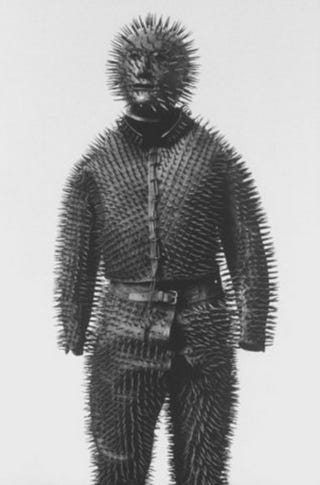
    Like this, but somehow more horrifying


    Light sources: The Moon is cold. It's also dark. Even during the day, it's a doomed adventurer who forgets about light. There's no (or at least very little) atmosphere on the Moon, and the sun shines with an intensity not known on Earth, but the Moon is riddled with rocky outcroppings and caves and forests of strange, petrified madness-trees, and you can be plunged into absolute darkness at any time. Ash-storms roil about on the surface, and the ancient halls of the dead beneath the ground have long been abandoned and rendered dark.

    Arc-Lamp
    Cost: 50 slugs, 10 minutes
    You can clip these lights to your suit. Provide them with a charge, either thaumaturgic or via a battery, and they produce a bright blue beam that cuts through darkness like a knife for 60-70'. They get hot. It takes about 6 hours before you would even start to feel that through a suit, but if you're just holding one, it's too hot to hold after about an hour of continuous use. They need to be hooked up to your oxygen supply, but they don't consume an about to be appreciable.


    Moonstone
    Cost: 175 slugs, 35 minutes
    Veins of luminescent silicate flow beneath the surface of the Moon like silver blood. It has a similar composition to the reified madness produced in an aurora by the polyp-trees. Most scholars agree that it is the same thing, but acted on by the miniscule pressure of the Moon over billions of years. Either way, the chunks of it glow brighter when shaken, so a lot of people put them in cages attached to their suits and power them that way. They're toxic, so don't touch them with your bare hands. If you do, roll on your favorite mutation or madness table and gain a random effect. Some people grind them up and snort them. They produce a soft white light in a 20' radius, or 40' if shaken vigorously, which then fades away after 3 rounds.

    This is gallium. Moonstone is like this but glowy

    Plutonium Orbiter
    Cost: 100 slugs, 20 minutes
    A bit of Plutonium, struck from an elemental. It circles your head and emits an etiolated orange light in a 5' radius, leaving tracers and emitting sine-wave sparks as it does. If someone casts a mind-reading spell on you, they catch some of the Plutonium as well, and it's pissed. Looking at it too long gives you a headache. You can cast the spell light (even if you don't know it or have spellcasting normally) on anything made of metal, as long as you keep ahold of it. The orbiter does 1 point of radiation damage every day you have it equipped, and after every month that passes, gain a cumulative chance to mutate.


    Vial of Lunar Slug Oil
    Cost: 20 slugs, 4 minutes
    Glass bottle with a steel stopper. A substance that isn't really oil, harvested from Lunar Slugs (creatures that aren't really slugs). It smells like lemons and graveyard wind, and glows intensely when fed meat. The oil is actually the slugs' way of reproducing, each drop containing millions of microscopic lunar slugs that are usually hibernating. When a food source is introduced, they begin feasting and fighting, causing the chemical reaction that makes them glow. After 5 feedings, the glow is dimmer as the slugs die, and after 10 one slug remains, large enough now as to fill the vial with no room to spare. When you find it, the vial has been fed 1d4+1 times already.


    Oxygen tanks: This is the main thing you need to survive on the Moon. Oxygen is so important that the entire lunar economy is based on how many minutes of it you have. In Cambridge and the Harvard Lunarium are quantum-paired banks that will exchange your slugs for minutes (represented by paper scrip), usually at a rate of 5 slugs to 1 minute (although this depends on your trustworthiness as a creditor). This might get complicated when calculating XP (I use currency as XP) so I might just make it 1:1, but I want oxygen to feel even more valuable than magic or food on the Moon.

    There aren't that many variants with oxygen tanks. They all contain about an hour's worth of air, and they all plug into the same adapters on your suits. However, the quality of oxygen differs, and some people pay more for air from certain parts of the world below. A shitty tank will only cost about 5 slugs, but if you get attacked and the to-hit is more than 18 the tank will leak. A good tank will set you back about 20 slugs.

    Some more loose adventurers add applicators to their tank supply, vials of gas that can be added to their oxygen to give them short-lived bonuses, like nitrous in cars.

    Laughing Gas
    Cost: 20 slugs, 4 minutes
    Anaesthetic and dissociative vapor, allows you to shrug off pain for 1d6 rounds. You can't stop laughing. When you take damage during this time, it is put off until the time that the gas wears off. You suffer no fear effects, and if an attack would kill you, you ignore it. If you recover that HP before the gas wears off, you live. Otherwise it all comes at once.

    Ghost Haze
    Cost: 30 slugs, 6 minutes
    Distilled from the souls of the dead found clustered on the Moon. Lets you and everything you're carrying become incorporeal for 1d4 rounds. If you're phasing in something when the effects wear off, you become stuck, and take 3d10 radiation damage. Otherwise can't take or deal damage in the ghost-state.

    Fumes of Leto
    Cost: 60 slugs, 12 minutes
    The Mad Mage Leto produced this vapor formula before he died and converted his mass into writhing bunches of worms. It allows you to see approximately 3 seconds into the future for one minute. The sensory ghosting and overloading is intense (Wisdom save or temporary insanity) but if you power through you can anticipate any incoming attacks, and your attacks do an additional 1d4 damage as you can target them more precisely.


    This is starting to get long, so I think I'll end it here. But I still have some ideas about weapons and stuff, maybe transportation.